
TABLE OF CONTENTS
- 1 What Are Google’s AI Overviews?
- 2 AI Overviews Prioritize Clear, Direct Answers
- 3 Authority Still Matters—But It’s Evaluated Differently
- 4 Content Quality Signals Are Amplified
- 5 Structure and Formatting Play a Bigger Role Than Ever
- 6 AI Overviews Reward Intent Matching, Not Keyword Stuffing
- 7 Owned Content Is More Important Than Ever
- 8 AI Visibility Is a Long-Term Strategy, Not a Shortcut
- 9 What This Means for Businesses Moving Forward
- 10 Why This Matters
- 11 Final Thoughts
- 12 Ready to Improve Your Visibility in AI Overviews?
Learn how to rank in AI Overviews by aligning content with authority, intent, and GEO best practices as Google’s AI-driven search continues to evolve.
Google’s search experience is changing fast and AI Overviews are one of the clearest signals of where things are headed. These AI-generated summaries now appear above traditional organic results for many informational and commercial queries, reshaping how visibility, authority, and traffic work.
If you’re trying to understand how to rank in AI Overviews, the short answer is this: it’s less about gaming a new system and more about aligning your content with how Google’s AI evaluates usefulness, authority, and clarity.
Below is what we’ve learned from testing, observation, and performance data as AI Overviews continue to roll out.
What Are Google’s AI Overviews?
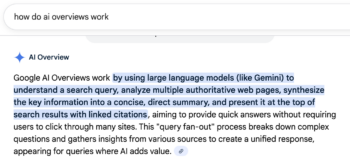
AI Overviews are Google-generated summaries designed to answer a user’s question directly within the search results. Rather than ranking pages alone, Google’s AI synthesizes information from multiple trusted sources and presents a consolidated response.
This shift changes how visibility works. Being included in an AI Overview means your content is no longer just competing for clicks—it’s being evaluated as a source of truth. That distinction is critical when thinking about how to rank in AI Overviews.
From a practical standpoint, AI Overviews signal that Google is prioritizing clarity, authority, and usefulness over traditional ranking mechanics.
AI Overviews Prioritize Clear, Direct Answers
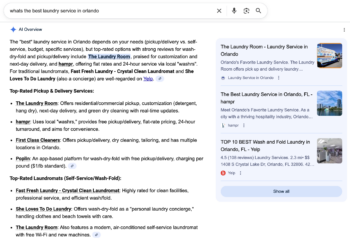
One of the clearest patterns we’ve observed is that AI Overviews favor content that answers the primary question quickly and without ambiguity. Google’s AI is designed to extract information efficiently, which means it relies heavily on how clearly an answer is presented.
Content that performs well typically removes friction for both users and machines. The easier it is to understand your point, the more likely it is to be used.
Pages that align with this expectation tend to:
- Address the primary question early on the page
- Use plain, precise language instead of marketing-heavy copy
- Present answers in a way that doesn’t require interpretation
This doesn’t mean long-form content is ineffective—it means structure and prioritization matter more than length.
Authority Still Matters—But It’s Evaluated Differently
Authority has always been a ranking factor, but AI Overviews appear to evaluate it more holistically. Rather than assessing authority at the page level alone, Google’s AI looks for signals of consistency and subject-matter depth across an entire site.
This is where many brands struggle. Publishing one strong article is no longer enough. AI systems want confidence that a source understands a topic comprehensively.
We’re seeing stronger visibility when brands:
- Publish multiple high-quality pieces around a core topic
- Demonstrate expertise across related subtopics
- Maintain consistent terminology and messaging
For businesses focused on how to rank in AI Overviews, this shift reinforces the importance of topical authority over isolated wins.
Content Quality Signals Are Amplified
AI Overviews raise the bar for what qualifies as “good” content. Surface-level explanations and generic summaries are far less likely to be referenced, even if they rank traditionally.
Google’s AI appears to favor content that reflects real experience and thoughtful analysis. This aligns closely with E.E.A.T. principles, but the evaluation occurs more quickly and decisively.
High-performing content often:
- Reflects hands-on experience or firsthand knowledge
- Offers original insights or practical takeaways
- Uses accurate, specific language
- Avoids exaggerated claims or buzzwords
In short, content needs to sound like it was written by someone who knows the subject—not someone chasing rankings.
Structure and Formatting Play a Bigger Role Than Ever
How your content is organized plays a major role in whether AI systems can use it. Clear structure makes it easier for Google’s AI to interpret, summarize, and trust what you’ve published.
This is why formatting should be treated as a strategic decision rather than a stylistic one.
Pages with stronger AI Overview visibility often use:
- Clear, descriptive H2 and H3 headings
- Short, focused paragraphs
- Bulleted lists where clarity matters (like this one)
- Simple sentence construction
If your content is difficult to scan or parse, it’s far less likely to be referenced—regardless of how well it ranks organically.
AI Overviews Reward Intent Matching, Not Keyword Stuffing
Exact-match keywords still matter, but AI Overviews rely far more on intent alignment than repetition. Google’s AI is designed to understand what the user is actually trying to accomplish, not just what they typed.
Content that performs well typically goes beyond the initial question and provides supporting context that satisfies the full intent behind the search.
Strong-performing pages usually:
- Fully address the user’s underlying question
- Anticipate related or follow-up questions
- Use natural language variations
- Avoid over-optimized phrasing
For anyone focused on how to rank in AI Overviews, this means completeness and clarity consistently outperform keyword density.
Owned Content Is More Important Than Ever
AI Overviews heavily favor content that lives on authoritative, owned domains. This reinforces the importance of your website as a long-term asset—not just a marketing channel.
Google’s AI frequently pulls from:
- Corporate blogs
- Educational resource hubs
- Industry guides
- Established service pages
If your expertise isn’t clearly documented on your own site in an indexable, structured way, it can’t be referenced.
AI Visibility Is a Long-Term Strategy, Not a Shortcut
There is no one-time fix for AI Overview visibility. Inclusion is earned gradually through consistency, quality, and alignment with how AI systems evaluate trust.
Much like traditional SEO, results compound over time—but AI Overviews compress the importance of credibility. Sources either demonstrate reliability or are excluded.
Visibility is built through:
- Consistent publishing around core topics
- Strategic content optimization
- Ongoing refinement based on performance data
What This Means for Businesses Moving Forward
If your digital strategy is still focused only on ranking traditional organic results, you’re already behind. Understanding how to rank in AI Overviews requires expanding your approach to include:
- SEO
- AEO (Answer Engine Optimization)
- GEO (Generative Engine Optimization)
Together, these disciplines ensure your content is discoverable, understandable, and usable by both search engines and AI-driven systems.
Why This Matters
At South Street & Co., our approach to AI visibility is grounded in Generative Engine Optimization (GEO)—the practice of structuring, optimizing, and publishing content so it can be accurately interpreted, trusted, and cited by AI-driven systems like Google’s AI Overviews.
Our GEO services build on traditional SEO but go further by:
- Structuring content to answer questions clearly and extractably

- Strengthening topical authority across related content clusters
- Aligning on-page content with conversational, intent-driven queries
- Reinforcing E.E.A.T. signals through owned, authoritative content
- Optimizing formatting, language, and context for generative engines
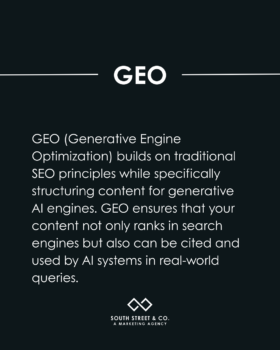
Rather than chasing short-term visibility, GEO focuses on making your website a reliable source that AI systems want to reference. This is precisely what we see rewarded in AI Overviews—and it’s why GEO is now a critical layer of modern search strategy.
Final Thoughts
AI Overviews are not replacing SEO—but they are redefining it. The brands that win will prioritize clarity, authority, and usefulness over shortcuts and outdated tactics.
If you want your content to remain visible as search evolves, the focus should be simple: create content that deserves to be referenced.
That is the real path to understanding how to rank in AI Overviews.
Ready to Improve Your Visibility in AI Overviews?
If you’re serious about future-proofing your search visibility, you need a strategy that goes beyond traditional rankings.
Contact us today to book a complimentary call to review your current content, evaluate how it’s positioned for AI-driven search results, and determine whether a GEO-led strategy can help your business earn visibility in Google’s AI Overviews and beyond.